
- Proactive Proving Period: New trucking operations launched in 2026 do not automatically wait until the standard August 31st tax deadline; your initial filing window is determined by the specific month your vehicle first hits public roads.
- The Registration Gatekeeper: You cannot secure your permanent International Registration Plan (IRP) plates or state commercial registration without an official, IRS-stamped Form 2290 Schedule 1.
- IRS EIN Traps: A newly generated Employer Identification Number (EIN) takes roughly 10 to 15 business days to clear the IRS e-file database. Filing too early causes immediate system rejections.
- Suspended Tax Exceptions: Vehicles projected to log fewer than 5,000 miles (or 7,500 miles for agricultural trucks) during the tax year are exempt from payments but must still file a zero-liability tax return.
- The Digital Mandate: While the IRS strictly requires e-filing for fleets with 25 or more heavy vehicles, electronic submission is highly recommended for single-truck owner-operators to prevent administrative backlogs.
Launching a commercial transportation enterprise in 2026 is an exhilarating milestone, but it also drops you directly into a complex web of strict federal regulatory frameworks. Among the various compliance hurdles—such as securing your FMCSA operating authority, activating electronic logging devices, and setting up fuel tax accounts—the Heavy Highway Vehicle Use Tax (HVUT) stands as one of the most critical immediate financial obligations you face. If you operate a commercial motor vehicle with a taxable gross weight of 55,000 pounds or more, failing to establish immediate tax compliance can ground your new business before your trucks haul their very first load of freight.
According to Department of Transportation data tracking small carrier failures, administrative delays in state-level commercial registration frequently stem from a single, avoidable issue: the lack of a valid, IRS-stamped Schedule 1 proof of payment. For an asset-heavy startup juggling razor-thin margins and tight delivery contracts, a compliance backlog can cause severe cash-flow disruption. This definitive guide breaks down the essential steps of Form 2290 compliance for new trucking businesses started in 2026, offering actionable strategies to protect your operating authority, secure your plates, and keep your fleet moving.
The Proactive Filing Rule: Timing Your First Form 2290
A widespread piece of misinformation circulating among first-time owner-operators is that heavy vehicle taxes are only due during the standard mid-summer peak window. For established trucking operations, the annual filing period runs from July 1st through June 30th of the following year, with a fixed payment deadline of August 31st. However, new trucking businesses started in 2026 operate under completely different calendar rules for their initial filing.
The “Month of First Use” Matrix
Your startup’s initial compliance window hinges entirely on the exact calendar month your heavy highway vehicle first rolls onto a public road. Under IRS regulations, your initial Form 2290 must be filed and processed by the final day of the month following its month of first use.
To eliminate confusion, let’s look at how this rule applies across a launch calendar:
- Example A: You buy a semi-truck and drive it home on public roads in March 2026. March is your month of first use. Your deadline to file Form 2290 and pay the tax is April 30, 2026.
- Example B: Your corporate operating authority activates, and your first driver dispatches to pick up a load in October 2026. Your filing and payment must clear completely by November 30, 2026.
Because this initial tax liability is prorated, you only pay for the months your vehicle is actually active during the current compliance cycle. Failing to track this date accurately can trigger immediate late-filing penalties, throwing your startup’s accounting into a deficit from month one.
Step-by-Step Compliance Guide for 2026 Commercial Startups
Navigating tax portals can feel overwhelming when you’re managing day-to-day operations. Following this structured protocol will help you clear the IRS system quickly and securely.
Step 1: Navigating the 15-Day EIN Verification Delays
Before you can log into any tax portal, you must have a valid Employer Identification Number (EIN). You cannot file a Form 2290 using a personal Social Security Number (SSN).
For a business launched in 2026, this step contains a hidden bottleneck: when you generate a new corporate EIN online, the internal IRS database can take 10 to 15 business days to sync that number across its electronic filing networks. If you attempt to submit your Form 2290 through an e-file provider within this two-week window, the IRS system will reject the return, stating that your business name and EIN do not match. Plan for this delay during your setup phase so your launch timeline stays on track.
Step 2: Gathering Fleet Data
Ensure you have an immaculate spreadsheet detailing your equipment specs:
- Employer Identification Number (EIN): Double-checked against your official CP 575 IRS confirmation letter.
- Legal Business Name: This must exactly match the formatting on your corporate filing documents (including capitalization, spaces, and punctuation).
- Vehicle Identification Numbers (VINs): Every digit matters. Typos on a VIN mean your stamped Schedule 1 will not match your equipment, forcing you to file an amendment down the line.
- Taxable Gross Weight Category: Determined by combining the empty weight of the truck-tractor, the empty weight of your heaviest trailer, and the maximum weight of the heaviest load you intend to haul.
Step 3: Determining Your Weight Category (Categories A through V)
Heavy highway vehicles are grouped into weight brackets starting at 55,000 pounds (Category A) and increasing in 5,000-pound increments up to 75,000 pounds. Any vehicle tipping the scales over 75,000 pounds falls into Category V, which carries the maximum standard annual tax liability of $550.
Logging Low-Mile Exceptions: The Suspended Vehicle Rule
For specialized business models—such as local logging, short-haul aggregate transport, or regional agricultural operations—your heavy vehicles might rarely hit interstate speeds or rack up long distances. If you anticipate that a vehicle will be driven fewer than 5,000 miles on public highways during the tax year, it qualifies as a Suspended Vehicle (Category W).
A common pitfall for new fleet operators is assuming that an exemption from payment means an exemption from filing altogether. This is incorrect. You must still submit a proactive Form 2290 to the IRS listing the truck’s VIN under the suspended vehicle section. The IRS will return an official Schedule 1 with a tax assessment of $0. This document is essential; without it, state authorities will refuse to issue your registration.
Why the Stamped Schedule 1 Controls Your Launch
The primary reason to prioritize your Form 2290 filing isn’t just about avoiding IRS penalties—it’s about keeping your business operational. The stamped Schedule 1 acts as the universal gatekeeper for your fleet’s physical deployment.
[File Form 2290] —> [Receive Stamped Schedule 1] —> [Secure IRP Registration] —> [Legal Fleet Deployment]
Under federal law, state Departments of Motor Vehicles (DMVs) and IRP registration offices are prohibited from issuing permanent commercial license plates or processing title adjustments without verifying a valid, current-year Schedule 1. If you attempt to register your vehicles using a printout of an unsubmitted tax form or a basic bank debit confirmation, your application will be denied.
When you file paper forms by mail, getting your physical stamped copy back from the IRS can take six to eight weeks. For a new business started in 2026, a delay of that length can stall your launch. Choosing an authorized online e-file partner allows you to secure a digital, watermarked Schedule 1 in your inbox within minutes of submission.
Navigating the 2026 Tax Payment Channels Securely
Once your software computes your prorated heavy vehicle use tax liability, you must choose a secure channel to send those funds to the U.S. Treasury.
Option A: Electronic Funds Withdrawal (EFW)
The fastest approach for modern e-filers. EFW allows you to input your commercial checking account routing and account numbers directly into your secure e-file software. The IRS processes the debit request immediately upon approving your tax return. Just ensure your bank doesn’t have an active ACH corporate block that could disrupt the payment.
Option B: The Electronic Federal Tax Payment System (EFTPS)
For fleet operators who prefer not to authorize direct bank debits through third-party software, EFTPS provides a highly secure alternative. Managed by the U.S. Department of the Treasury, this dedicated portal lets you log in independently to schedule your payments. Keep in mind that setting up a new EFTPS profile requires receiving a physical PIN by mail, so this option isn’t ideal for tight, last-minute deadlines.
Option C: Physical Check with Form 2290-V
If your corporate policies require physical check processing, you must mail your check along with Form 2290-V (Payment Voucher) to the IRS center in Charlotte, North Carolina. To protect against mail interception fraud, always hand-deliver your payment envelope inside a U.S. Post Office facility and ship it via USPS Certified Mail with Return Receipt Requested.
Audit-Proofing Your Fleet for the FMCSA Carrier Safety Review
Within the first twelve months of kicking off your operations, every new interstate trucking business must undergo a mandatory FMCSA New Entrant Safety Audit. While this review focuses heavily on your driver drug-and-alcohol clearinghouse profiles, driver logs, and maintenance records, safety auditors will also cross-reference your operational records with your tax filing history.
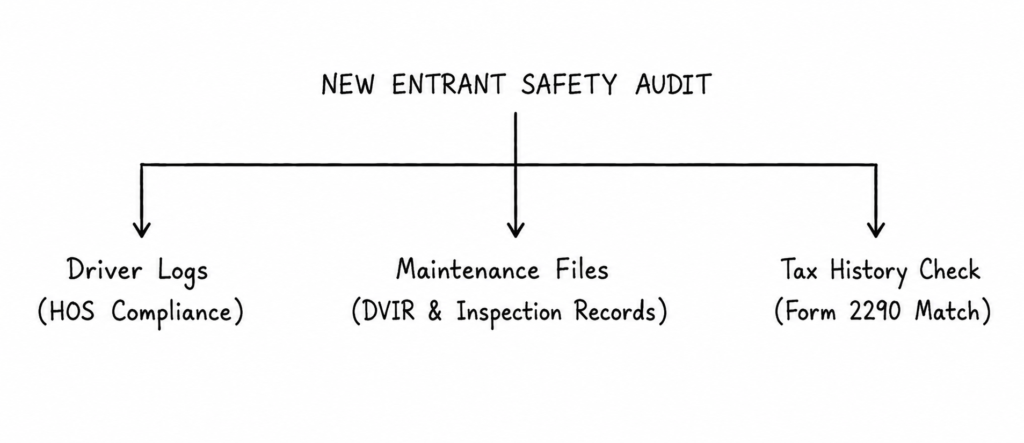
If an auditor discovers that your trucks were hauling freight across state lines during months when your business lacked a valid Form 2290 filing, it can raise red flags regarding your broader compliance management. Ensuring your tax paperwork is filed correctly and on time demonstrates to regulatory bodies that your business is built on a solid foundation of operational compliance.
Frequently Asked Questions (FAQ)
Q1: I bought my first commercial truck in June 2026. Do I file for the current tax year or wait for the next annual cycle?
A: Because your month of first use is June, you fall into the very tail-end of the preceding tax year cycle. You must file a prorated Form 2290 for that single month of activity by July 31, 2026. Right after that, you will also need to complete your standard, full-year Form 2290 filing for the upcoming tax year cycle (running July 1, 2026, through June 30, 2027), which is due by August 31, 2026.
Q2: What are the consequences if the IRS audits my new trucking business and finds an incorrect VIN on my Schedule 1?
A: An incorrect VIN on your Schedule 1 technically invalidates your proof of payment for that specific truck. If discovered during a state roadside check or an FMCSA safety review, your vehicle can be flagged for registration non-compliance. To fix this, you must file a Form 2290 VIN Correction amendment through your e-file provider right away. This amendment processes quickly and generates a corrected Schedule 1 matching your truck’s physical dashboard plates.
Q3: Can I transfer my pre-paid Form 2290 tax credit if I trade in my heavy vehicle for a new model in 2026?
A: Yes. If a vehicle is sold, destroyed, or stolen during the tax year before logging 5,000 miles, you may claim a credit for the remaining prorated months. You can apply this tax credit directly to your next Form 2290 filing for the replacement vehicle by detailing the original truck’s VIN and transfer dates within your electronic filing platform.